Life on the Weald - February 2023
and at home in the kitchen and the garden
Although there may not be much to feed us on the allotment at the moment, we still have some produce from last year. We have just eaten the last of the Crown Prince squashes, harvested in the autumn of 2022 and it was in excellent condition. We still have a butternut squash and a couple of pumpkins to keep us going!
 |
| Crown Prince Squash |
The first week of February was unseasonably warm with temperatures reaching 11C during the day and it was feeling almost spring-like. The Camellia was coming into full flower in the garden, the crocuses were out on the lawn and we had our first daffodil, a month early. The rhubarb was also looking promising.
 |
| Daffodil, Camellia, crocuses and rhubarb - 2 February |
On 2 February I sowed more tomatoes in seed trays at home - another beefsteak variety, Ananas, which has an orange/red skin and yellow/orange flesh with few seeds; Rainbow, a colour mix of baby plum tomatoes; and two cherry varieties, one red,Cherry belle, and the other yellow, Sungold. According to the seed packet, this is what the Rainbow variety should look like.

The Marmande and Tres Cantos, sown on 4 January had sprouted by 16 January and now have their true leaves and are almost ready for potting on.
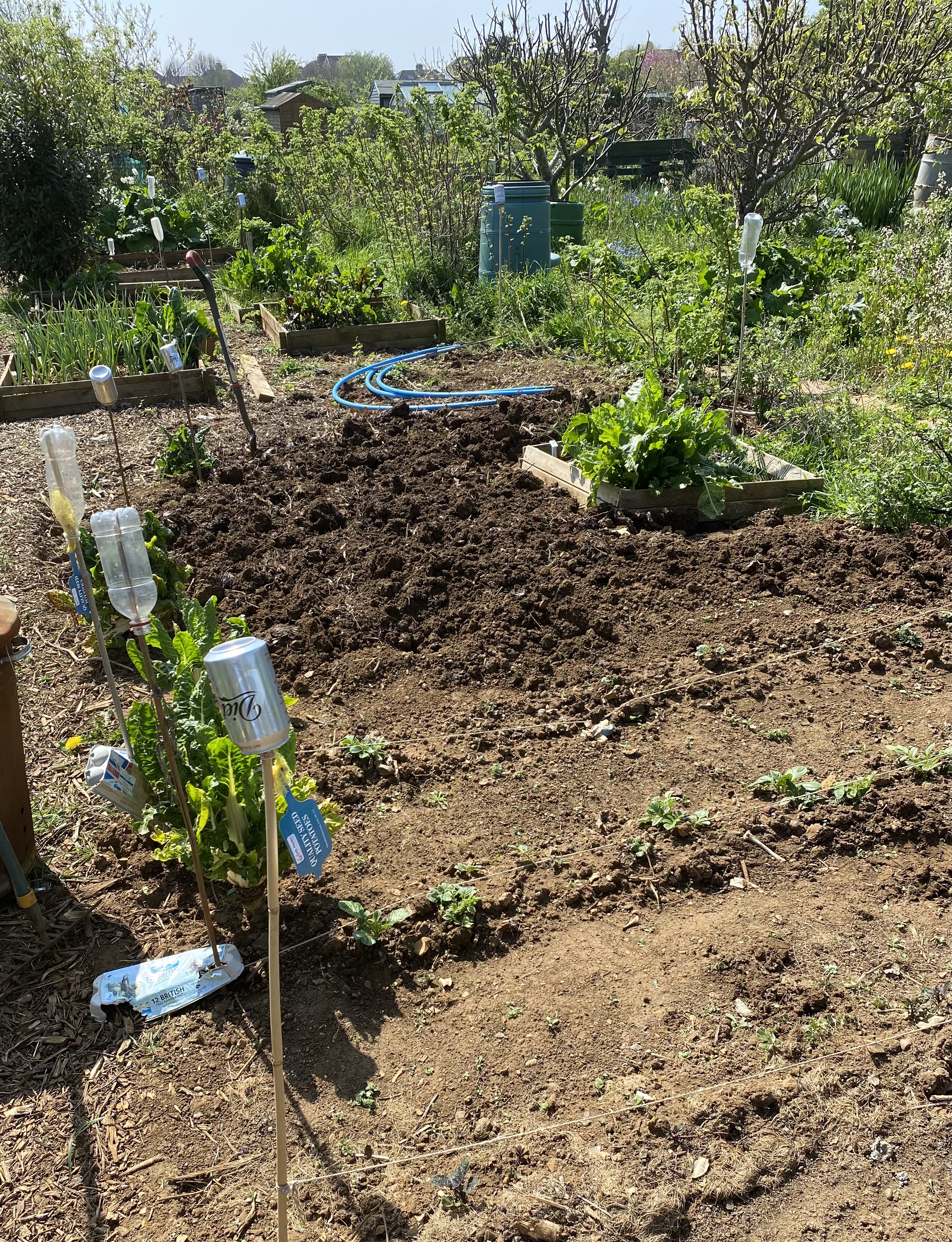
With a daytime temperature of 11C, 2 & 3 February were ideal days to be working on the allotment. We topped up some of the raised beds with worm compost from the wormeries (Sylvi is in charge of the wormeries) and I decided to clear the area where the potatoes are to be planted which had a lot of perennial weeds - bindweed, couch grass as well as blistery oxtongue. The oxtongue is great for butterflies and moths, so I am happy for it to grow on the margins of the plot, but not where my potatoes are to go! I have resolved, however, that this is the last time I will dig this area as I intend to convert it to a "no dig" bed later in the autumn (but more about that later).
 |
| 2 February - healthy worm compost |
.jpg) |
| 3 February - almost ready for potatoes |
The weekend turned distinctly cooler, however, with sub-zero temperatures at night and heavy frosts in the morning. I stayed indoors on Saturday 4 February and potted up the Marmande and Tres Cantos tomatoes.
Sunday 5 February saw the return of the annual Brighton Seedy Sunday, the UK's largest seed swap event. I managed to obtain a few seeds but the highlight was a presentation by Charles Dowding, the "father of no dig gardening".
I had already taken a step to no-dig gardening in 2021 by creating three Hugel beds. I added another in 2022 by burying some old logs, twigs and other organic matter
On the following day, Monday 7 February, inspired and enthused by the Charles Dowding talk, I started to create a new "no-dig" area following his advice not to use frames which only act as a safe place for slugs and snails to breed. The secret of the Dowding method is cardboard and compost - simply put down a layer of cardboard and cover it with 4-6 inches of compost. The cardboard will rot down in 6 weeks or so, and provided the compost is well rotted planting can begin immediately. The carboard will also provide a temporary barrier to weeds.
I chose the area on the east of the plot between some raised beds and the fruit bushes on the boundary, an area which was full of weeds.
 |
| 6 Feb - the area chosen for the no-dig bed |
Fortunately I had a reasonable supply of cardboard as we had recently purchased some office furniture from IKEA. I laid this directly on the ground on top of the weeds. I had three barrow loads of well rotted horse manure which had been sitting in a pile on my plot for a few months. I mixed this with some partly rotted leaves from my compost bins and some worm compost from the wormeries and a bag of commercial organic, peat free compost and spread this on the cardboard.
 |
| 6 Feb - the no-dig bed begins |
 |
| 6 Feb - the no-dig bed begins |
After the hard graft we did manage to pick some rainbow chard.
 |
| 6 Feb - Rainbow chard |
At home I sowed some Chervil seeds, which I had acquired at Seedy Sunday, in a tray indoors and also some more Aquadulce broad beans.
On 8 February the Sungold tomatoes, had germinated and were beginning to sprout but there were no signs of any of the others. The recommended temperature for germination is 18-21C. The rest of the house gets to that temperature but the heating in the conservatory is not on, although it does benefit from the warmth of the house, but probably doesn't get beyond 15C which might explain the delay in germination.
Fortunately, there had been a delivery of woodchip to our site and I laid some to surround the new bed. I also used it as a mulch for the fruit bushes.
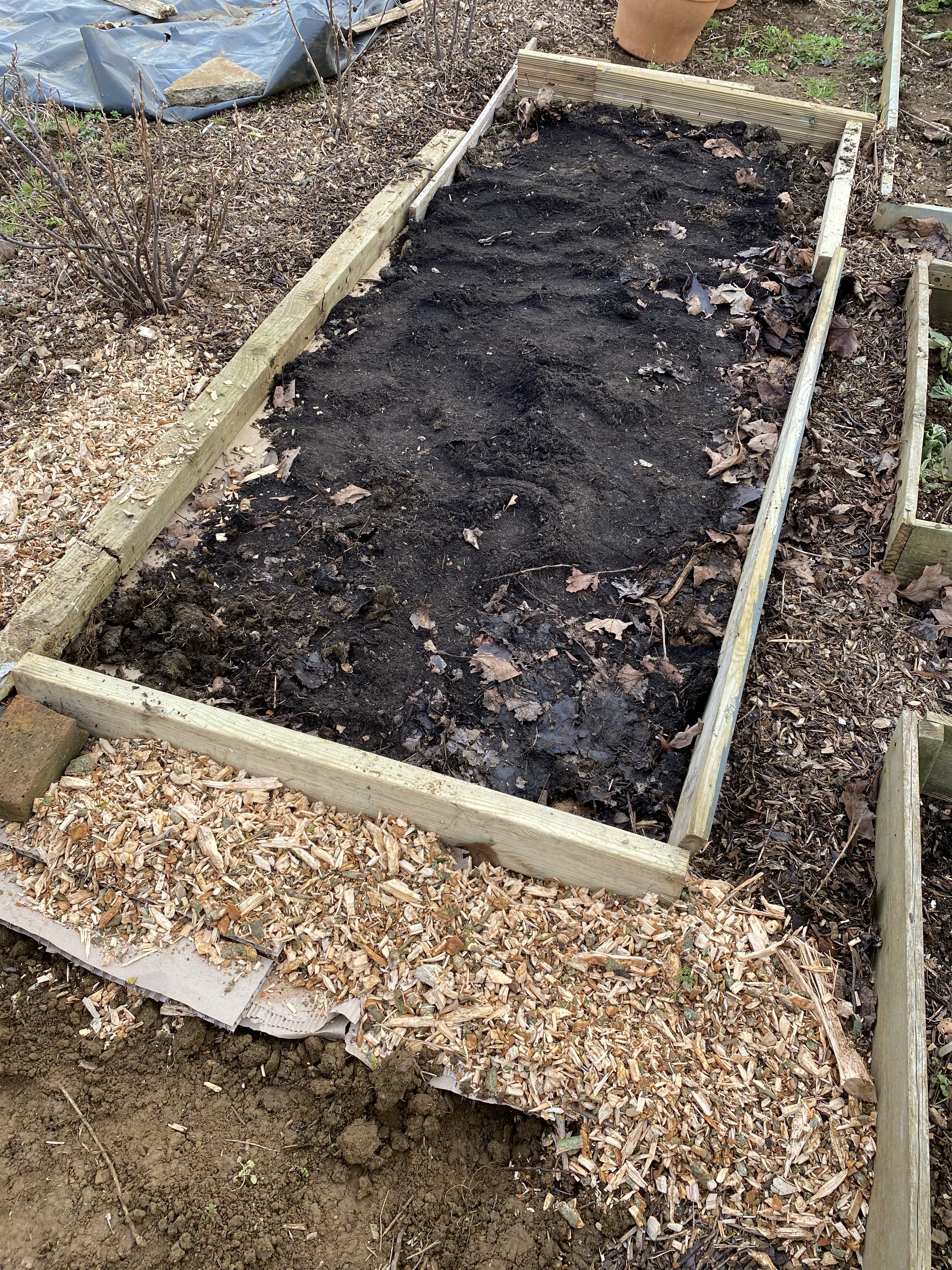 |
| 10 Feb - the new bed nears completion |
At home the broad beans that had been sown six days earlier had germinated and were now sprouting.
Sylvi had been busy clearing the area around the apple tree and cutting down the brambles and on 11 February we dug out some of the deep rooted ones. In addition to the brambles, Sylvi had dug up some old synthetic carpet which was there when we took over the plot and which we will need to take to the civic amenity site.
 |
| 11 Feb - the area around the apple tree |
Another job that needs doing is to add some more ericaceous compost to the blueberries. They need an acid soil and as we are on chalk they are grown in containers with compost formulated for azaleas and rhododendrons.
 |
| 11 Feb - the blueberries |
The site was beginning to look a lot tidier on the eastern side (plot 247B) but we will soon have to tackle the western half (247A), where the brassicas, sown in 2022, are currently growing, but which will become home for the French beans, runner beans, cucumbers, courgettes and squashes later this year.
 |
| 11 Feb -Plot 247B |
On the eastern side, I dug a very shallow trench where I will plant the first early potatoes, and lined it with torn up eggboxes (which will eventually rot down) and aid water retention and then I part filled the trench with some organic peat-free compost.
 |
| 11 Feb - the potato trench |
As the weather was warming up, I decided to remove the cover from the forced rhubarb
 |
| 11 Feb - Rhubarb |
Following on from the success of the Charles Dowding talk at Seedy Sunday, the allotment Association, WAGA, (Weald Allotments & Gardeners' Association) and the Brighton and Hove Organic Gardening Group (BHOGG) arranged a practical "no-dig" workshop on Sunday 12 February. It was a great opportunity not only to learn more but to meet and exchange information with other plot-holders - it was a very successful social occasion.
.jpg) |
| 12 Feb Andy - Chair of WAGA starts the session |
.jpg) |
| 12 Feb On Andy's plot |
On 13 February, the broad beans that I had sown indoors 7 days earlier were progressing well and the tomatoes that I had potted on were looking healthy.
 |
| 13 Feb - broad beans (sown 6 Feb) |
 |
| 13 Feb - Marmande and Tres Cantos tomatoes |
The mice/rats or squirrels had dug up some of my broad beans so on 13 February I directly sowed some more in the gaps. I'm keeping my fingers crossed but will have the indoors sown ones in reserve.
We also made a start on another "no-dig" area on the western half (plot 247A) near where the tumble compostor is currently sited but which will soon be moved. We had already emptied its contents, which were partly composted, into a pile on the ground. We put down a layer of cardboard and piled some of the partly rotted compost on top and covered it with a tarpaulin with the hope that the composting will be complete before we need to finish the bed.
 |
| 13 Feb - another new no-dig bed |
 |
| 13 Feb - the no-dig bed with temporary cover |
As we still had some cardboard to spare, I laid this around some of the gooseberry bushes and covered it with woodchip as a mulch.
 |
| 13 Feb - Gooseberry bushes |
There was glorious spring-like weather on 15 February with an afternoon temperature of 14C. I sowed some radishes (Nelson), a fast growing cylindrical variety which should produce by early April. Only four of our asparagus plants survived last year, so I bought another 4 crowns (Pacific Purple) but the asparagus bed was in dire need of attention as the raspberries had invaded. I spent a busy morning digging out the unwanted raspberry canes which were very deep-rooted. This was difficult to do without disturbing the surviving asparagus plants. I also had to dig out several raspberry canes that had invaded the path between the two asparagus beds. Having cleared the beds as best I could, I added a layer of compost and planted the new crowns and hopefully we will get some produce from them in a year or two's time but we hope that the existing crowns have not been disturbed too much and will produce this year.
It may turn out to be a mistake, if we are suddenly hit with an extreme cold spell, but I also planted my first row of Red Duke of York, first early potatoes in the trench I had prepared earlier.
Whilst this was going on, Sylvi spent a few hours continuing to tackle the brambles around the apple tree which were also engulfing the plum trees along our boundary. In addition to the brambles, there was couch grass and bindweed to contend with. Once it is finally cleared (although the brambles cannot be totally removed as their roots go down several feet) we will lay cardboard before covering with a mixture of compost and topsoil.
I looked at the indoor sown broad beans on 17 February and they looked ready for transplanting, so I put them in the cold mini-greenhouse in the garden to harden off.
 |
| 17 Feb - broad beans |
The sungold tomatoes were thriving but only a few of the Ananas appeared to have germinated.
.jpeg) |
| 17 Feb - Sungold and Ananas tomatoes |
 |
| 17 Feb - Rainbow plum tomatoes |
Sunday 19 February was another bright sunny day. One of the plotholders was giving away a compost bin - well you can never have too many so I acquired it. I placed it where the beans will grow next to the tumble compostor which is to be moved next week. I cleared the pile of partly composted material which I had tipped out of the tumbler and put it in the new compost bin.
 |
| The tumble compostor |
 |
| The new compost bin |
We also began constructing a frame for netting over the new no-dig bed as this will be home for some of the brassicas later in the year which will need protection from pigeons. We had some Blue MDPE (Medium Density Polyethylene) water pipe which we used to construct the frame for the netting. (MDPE pipe is readily available in DIY/hardware stores and online)
 |
| the new no-dig bed |
At home I sowed some red cabbage, red drumhead, and Perpetual spinach (beet) in trays in the unheated conservatory.
20 February reached 10/11C but it felt more like 4/5C with the wind. I spent much of the time on my knees, out of the wind, tracing back some bindweed with the 3-tine hand hoe around the red currants. Having removed as much as I could without digging, I laid more cardboard and topped with a bit of compost then the last of the woodchips.
 |
| 20 Feb - some of the bindweed roots |
 |
| 20 Feb - the redcurrants mulched |
I also cleared some of the encroaching couch grass by the pond and replanted some of the black lilies which had been choked by the couch grass, but there is also a problem of suckers from the plum tree in the area where we want wild flowers to flourish.
The following day, 21 February, started with fine drizzle and there was still a fresh breeze. The drizzle stopped around mid-morning and we spent about three hours together on a cold damp day generally tidying up.
I decided to have another go at the area around the pond. I couldn’t dig out the miriad of plum suckers. I managed to pull up some, although the main root will still be there ready to send up more suckers and I cut any remaining ones just below the surface with secateurs. I fear this is going to be like painting the Forth Bridge.
Earlier in the month, the pigeons had been having a feast on the early broccoli plants which weren't inside the cage. I did put a net over them but thought it might be too late as the damage had been done. I was pleasantly surprised to see that the florets had begun to be formed and there should be some for picking later in the week.
 |
| 21 February - Purple sprouting broccoli |
 |
| 21 February - Purple sprouting broccoli |
I planted out the broad beans that had been sown at home as they were getting rather leggy.
 |
| 21 February - broad beans |
 |
| 21 Feb - a half row of Duke of York |
In the new no-dig bed I planted some Kelvedon Wonder early peas that I had bought at Seedy Sunday. My theory is that we should get a crop before the brassicas need to be planted there.
Sylvi spent most of the time continuing to tackle brambles and couch grass around the apple tree and along the eastern boundary with our neighbour. We also managed to move the tumble compostor, the drum of which is in need of some TLC before we start filling it again.
The following two days were cold and wet with light drizzle but I did visit briefly on Thursday 23 February to check on the broad beans that I had planted out on Tuesday. They looked fine but something - I suspect a squirrel - had been digging holes where I had planted potatoes. I don't think they were after the potatoes, probably something in the organic matter/compost. Although they had lifted a couple of potatoes, they were lying on the ground but there was no damage so I replanted them.
At home, I sowed some Kalettes indoors and also some more Cherry Belle tomatoes as there was no sign of the ones sown earlier. I noted from the seed packet that they were from 2021, not 2022 as I thought, so it is possible the seeds have deteriorated.
On 25 February there were signs that the red cabbage and beet spinach had germinated after only 6 days.
 |
| 25 February - Drumhead red cabbage |
 |
| 25 February - spinach beet |
On the plot, I lifted the last of the parsnips (including the ones nibbled by rodents) and continued to clear around the pond.
 |
| 25 February - parsnips |
We also picked the first of the broccoli from the plants ravaged by the pigeons,
 |
| 25 February - purple sprouting broccoli |
Only a day later - 26 February - the red cabbage and spinach had put on some growth and the chervil was deveoping its first true leaves.
 |
| 26 February - Drumhead red cabbage |
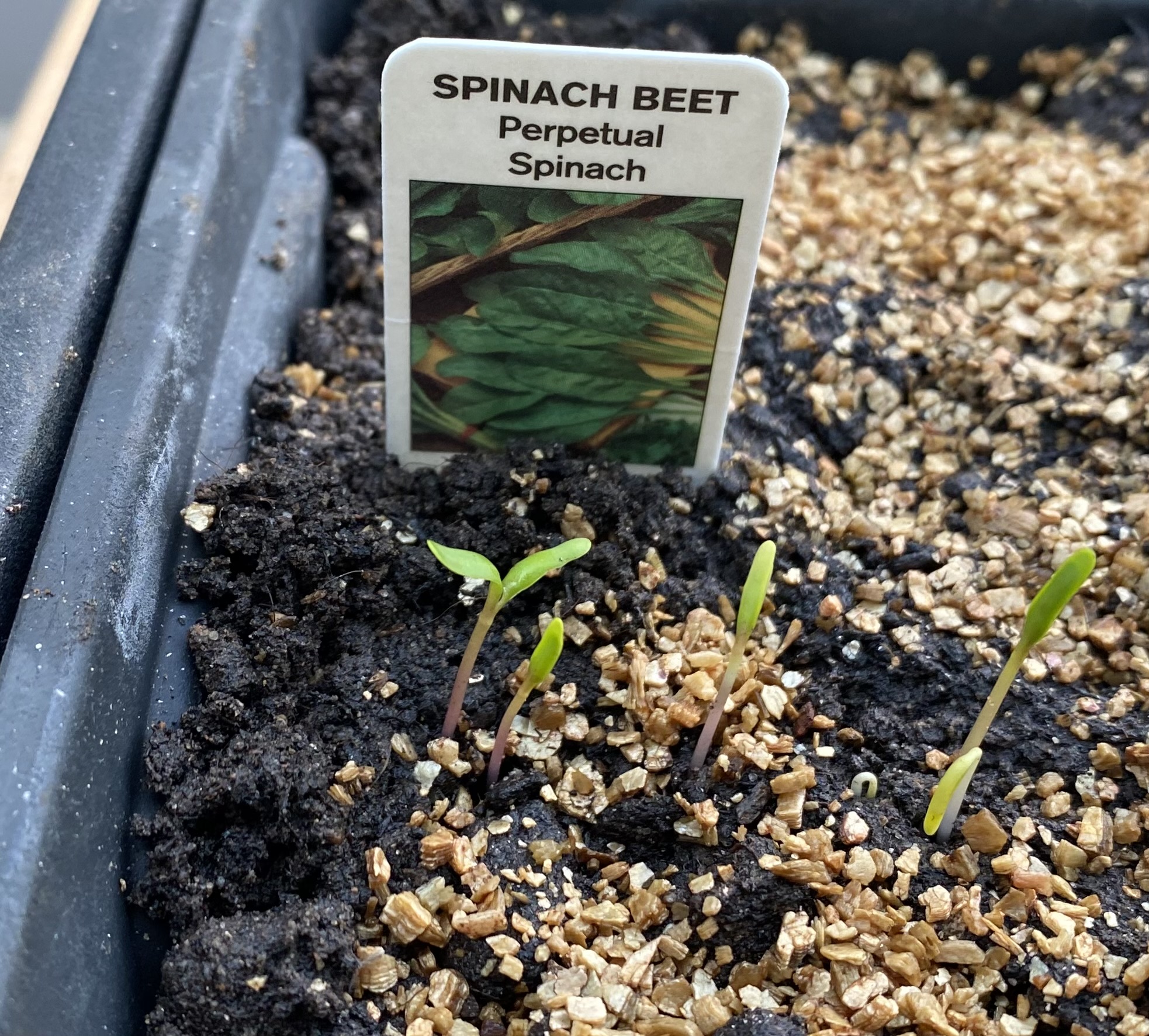 |
| 26 February - spinach beet |
 |
| 26 February - Chervil |
Over the weekend one of the plotholders had a disaster when their pond developed a leak and the water was rapidly draining away just as the frogs had spawned. As a general rule it is not advisable to move amphibian spawm from one location to another as this can spread disease but this was an emergency and the spawn could be rescued and transferred to ponds on the same site without too much risk.
So on Monday morning 27 February I gathered some of the spawn and rehomed it in my pond - from plot 232 to 247.
 |
| 27 Feb - frog spawn |
 |
| 27 February - our pond |
At home the chilli peppers that I had brought indoors in October were flowering and still producing.
 |
| 27 February - jalapeño |
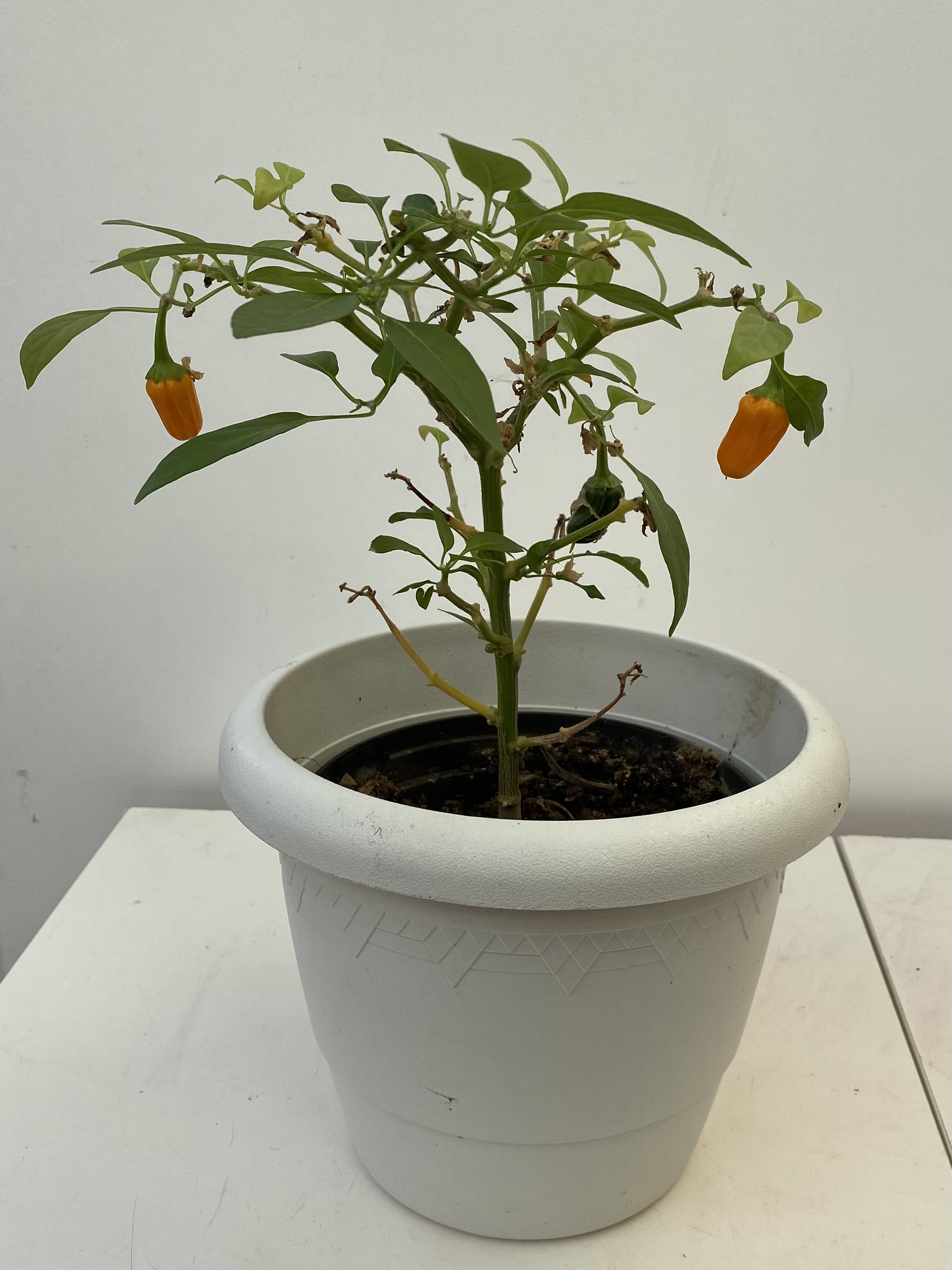 |
| 27 February - Orange Habanero |
On 28 February I began to liberate the table in the conservatory and transferred the tomatoes to a position under the skylight in the loft extension (which is also unheated when not lived in). The conservatory table may not be empty for long though as March/April becomes a very busy time for sowing.
 |
| 28 February - tomatoes in their new temporary home |
Looking back, the month had, for the most part, been unseasonally warm and dry , and hopefully we are well prepared for the busiest planting months ahead.
We are quite excited about our new acquisition - hoping they adapt well to their new environment and we look forward to seeing tadpoles soon
 |
| 28 February - our frog spawn |


.jpg)