It was a very cold start to December with the first really heavy frost. Nevertheless I went to the plot to sow some more broad beans, where the red cabbages had been growing, and then covered the area with fleece. With freezing fingers I decided not to stay too long.
1 December - a new row of broad beans
2 December
As the cold weather continued, I decided to stay at home and spend some time in the kitchen. I removed the seeds from the bulbous end of one of our butternut squashes and stuffed and roasted it.
2 December - butternut squash
2 December - roast, stuffed squash
6December
The cold spell continued and I had to scrape the ice from the car windscreen and despite the cold visited the plot. The temperature rose to 3C
6 December - a frosty morning
I removed the fleece from the garlic which now appeared to be firmly rooted. The fleece was more to protect the cloves from being pulled up by birds rather than to protect them from the cold. Garlic does well if it has two months at 0-10C.
6 December - garlic
6 December - garlic
I found some netting to put loosely over the broccoli that was outside the netted cage. The ground was quite hard on the surface but with all the rain we had recently was soft underneath so I thought digging out some couch grass and bindweed might keep me warm. This is the area where either the potatoes or brassicas will go next year.
6 December - couch grass removed
Back at home, it was clear that Christmas was on its way as the Schlumbergera (Christmas flowering cactus) was in bloom.
6 December - Schlumbergera
That evening there was heavy rain and several flood warnings.
7-14 December
The rain and stormy weather continued as Storm Erin arrived, followed by Storm Fergus and there was heavy flooding in the Midlands, the North and Scotland. We escaped the worst but it was miserable weather and not conducive to gardening.
15 December
There was a break in the rain so i paid a visit to a very wet and waterlogged plot. I had collected a lot of cardboard and laid this where the brassicas will go and covered it with the contetnts of two compost bins. The compost was not fully rotted but I am relying on the worms and fungus to do the rest. i did then cover the area with tarpaulin as more rain was threatened and I didn't want it to get too sodden.
I also managed to pick a lot of perpetual spinach for a warming sag aloo (spinach and potato curry) over the weekend
27 December
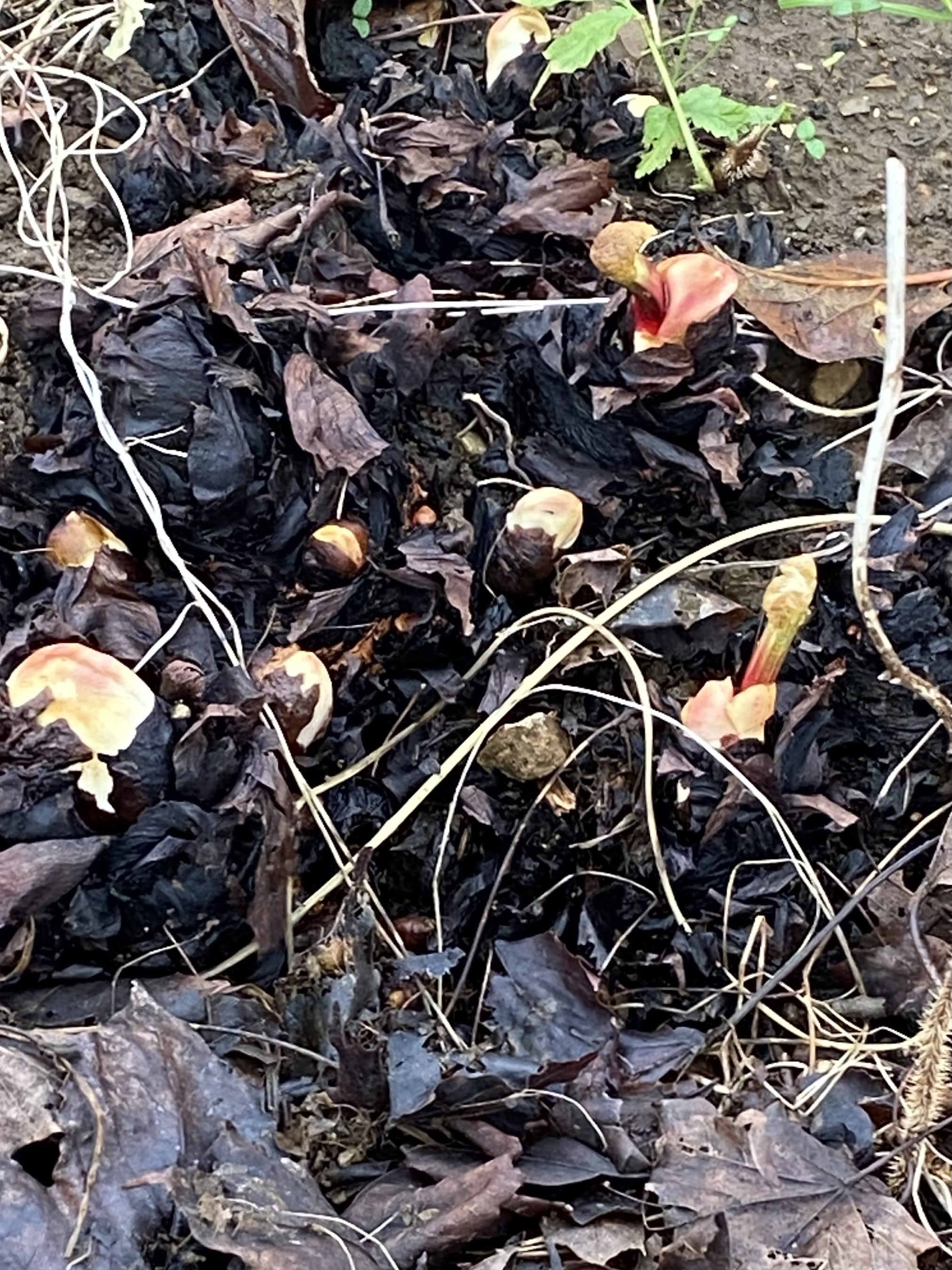
On my last visit of the year, I noticed that the rhubarb was beginning to show through, so it might be time to force it by covering with an old recycling container.
29 December
After many months of delays and cancelled appointments, I eventually had surgery on my right hand to correct Dupuytren's contracture - (a thickening of tissues in the palm of the hand causing one or more fingers to curl towards the palm, restricting certain functions). Whilst am pleased to have had the operation at last it might curtail my allotment activity for weeks and possibly months.
29 December
The sling comes off in a few days, but it will be a week or so before the dressing and plaster come off and the stitches removed but I will have very limited use for about a month and it will be longer before I can drive or do strenuous physical activity - but hopefully back to full activity for the spring.
November started with a rainy morning and a maximum temperature of 14C with the wind getting up in the afternoon and after Storm Agnes and Babet, in previous months, we were advised that Ciarán was due to strike that evening.
2 November
The wind was very strong in the night and a lot of the beach ended up on the promenade
4 November
The strong winds persisted although there was little damage from Ciarán in the south east compared to the rest of the country.
4 November - Hove beach
5 November
The damage on the allotment was minimal. Most of the covering on our derelict greenhouse had been blown away and the panels for our replacement shed had blown over but everything else was intact.
5 November - greenhouse
5 November - the shed
We found a good home for the Halloween pumpkins - the compost tumbler. They look happy there.
5 November - farewell Halloween
After a stormy night, it was a bright clear day and I lifted some of the Jerusalem artichokes
5 November - Artichokes
5 November - Artichokes
The broccoli was growing taller than the cage so i raised the netting to accommodate it.
6 November
Sylvia began to re-cover the greenhouse (which is just used as a storage area) and deal with invading brambles whilst I raised the netting over the kalettes which, like the broccoli, had outgrown the cage.
raising the netting over the kalettes
In raising the netting, I disturbed the whitefly which flew around in clouds. I decided to spray all the brassicas with an emulsion of natural oil and water with a little added soap.
I had a plentiful supply of fresh farmyard manure that our grandson, Jerome, had delivered from our allotment shop and I spread some of this on the raised beds where the onions will go in the spring.
I am supposed to be shedding responsibilities in retirement but have recently taken on the role of communications officer on the Allotment Association Committee and am responsible for its websiteand social media.
fresh manure
the onion beds
The newly sown broad beans were just beginning to germinate, so for a protection against slugs and snails I sprinkled a mixture of crushed eggshells and coffee grounds on the bed.
Broad beans beginning to sprout
I then cleared another raised bed of weeds, by hand weeding, (no digging) and laid cardboard ready for a layer of manure.
8 November
At home on a cold, dreary November day, I was wondering what to do with tromboncinos. We have tried them roasted, in risotto, in soups, with pasta - and then I remembered I had a recipe for a Courgette Lemon Drizzle Cakeso I decided to try it using tromboncino instead and I'm pleased to say it worked well.
Tromboncino Lemon Drizzle Cake
11 November
Jerome delivered another 3 barrow loads of manure, Sylvi continued to tackle invading brambles and I dismantled the bean and cucumber frames.
more manure
the old climbing bean frame
At home we decided to try one of the Crown Prince squashes
Crown Prince squash
The broad beans that we had sown in modules had sprouted and would soon be ready for plantiong out.
Broad beans
12 November
Taking advantage of the sunny weather I hand weeded another of the raised beds laid cardboard and covered with manure.
hand weeded raised bed
raised bed with layer of cardboard and manure
We harvested some red cabbage and beetroots...
red cabbage and beetroots
..... and I picked the remaining tromboncinos.
My efforts to tame the tromboncino!
13-18 November
13th and 14th were bright sunny days and ideal for gardening but unfortunately I was otherwise engaged! The following days were not so good but I was still busy with non-allotment issues and at the weekend my eldest grandson, Felix, and his partner came down for the weekend as Felix was running the Brighton 10k on the Sunday. It was a tough run with some rain and howling gale force winds.
Felix flying home
A first 10k for Felix
24 - 25 November
It had previously escaped my notice, but one of the trailing Crown Prince squashes had attached itself to a low branch on the apple tree and had climbed up about two metres! Now that the tree had lost its leaves, I discovered that the squash had fruited and there was a large one lodged in the branches!
Crown Prince in the apple tree
Crown Prince in the apple tree
With some difficulty I rescued the squash from apple tree...
Squash safely landed!
... and having got it home, it weighed in at a magnificent 4.5kg
4.5kg Squash
I sowed some more broad beans directly into a raised bed - you can never have too many and they freeze well.
26 November
I continued weeding around currant bushes and where the red cabbages had grown. I had intended to plant out the broad beans grown in pots at home but at midday the rain came down and I left the beans for another day. Heavy rain continued for the nexty couple of days.
29 November
At last there was a brtight clear sunny morning which enabled me to plant out the pot-grown broad beans
30 November
The last day of the month was also dry but the temperature dropped to zero overnight and by mid-morning it was only 3C in the morning and cloudy and I decided to stay at home in the warm!
The month began reasonably warm. On the first day of the month the temperature reached 19C, dropping to only 15C at night. We managed a good harvest of cucumbers and beetroot as well a a plentiful supply of Cavolo Nero.
1 October - Tuscan Kale (Cavolo nero)
There was limited time on the plot though - my grandson Felix was still with us but we also had a visit from my daughter, Zoë, and granddaughter, Kitty.
1 October with Felix, Zoë and Kitty
2 October
The following day, I harvested one of the Tromboncinos but I'm afraid it broke as I picked it
2 October - tromboncino
2 October - "it came apart in my hands"
When I got it home, I tried a temporary reconstruction, just for the photograph! It was about 1 metre long (as the crow flies!) but would have been much longer if only it had grown straight. And there are perhaps larger ones to come.
2 October
We made a start on it; we roasted slices with peppers, tomatoes and herbs and a hint of paprika.
2 October - tromboncino bake
3 October
In the wormery, the worms were doing their job and producing lots of compost and nitrogen-rich liquid fertiliser. For years, I have been calling this liquid "worm tea" but am now told that is wrong. Apparently worm tea is made by infusing worm casts - ie the digested material produced by worms and then filtering off the liquid. What drains from a wormery is "leachate", the liquid run-off from the decomposing vegetable matter that has not been digested by the worms. Some commentators suggest that use of leachate is not safe as it may contain pathogens and phytotoxic substances i.e. substances that are harmful to the growth of plants. We only put vegetable matter in our wormery (and occasional fish bones), never meat/animal products so the risk of pathogens is very low (and human pathogens such as E.coli or Salmonella are not harmful to plants and are present in the soil and on our hands anyway. We also dilute our leachate with water(around 1-10 ratio) and apply it to the soil, not the foliage, and only use it for well established plants. We also add it to compost bins/heaps as a nitrogen rich compost accelerator. In addition to nitrogen it is a good source of carbon, potassium and phosphorus. Having read numerous articles we do not think it is harmful if used in the way that we do and will continue to use it as a liquid fertiliser, believing that it contributes to healthy and vigorous growth, especially on our brassicas.
If I saw any evidence of harm, such as chlorosis (yellowing of the leaves) that would be a signal to stop using it.
3 October - a semi-composted tray
3 October - a fully composted tray
We began to spread some of the worm compost on the area where the potatoes had grown and where we had put down a layer of cardboard.
3 October - muck spreading
5 October
We had planned a few days away, firstly to visit Sylvi's nephew, Ross, in North Wales for his 40th birthday. and then a bit of site-seeing. As the remaining Marmande tomatoes had just begun to ripen, I thought I would pick them and bring them indoors to finish ripening and avoid the risk of the snails/slugs getting them whilst we were away.
5 October - Marmande tomatoes
We had hired a campervan for our journey, which proved to be eventful - although not in a good way! We collected the van from Horsham but soon after leaving the M25 as we were heading up the M40, approaching Beaconsfield, the clutch pedal jammed. We managed to get off the motorway on to the slip road and phoned for assistance to the hire company.
The Highways Agency arrived soon after but advised that we could not sit in the vehicle but had to move away as far as possible on the grassy bank.
arrival of the highway patrol
Initially, the weather was fine but soon clouded over and the temperature dropped. Fortunately the Highways Agency had given us some foil blankets.
a change in the weather
It was just as well that we had the blankets because it was 6 hours before the recovery vehicle came to pick us up and take us back to the depot in Horsham.
6 hours sitting by the roadside
It was not until 9pm - nine hours after we had first set off - that we resumed our journey, this time in our own car!
6 October
We stopped overnight north of Oxford, continuing our journey in the morning arriving in Denbigh around lunchtime. We took Ross for a stroll on the empty beach at Prestatyn. It was a bit breezy but sunny with clear blue skies.
6 October - Barkby beach - Prestatyn
We could have been in Hove looking out to the Rampion wind farm but this was the North Hoyle Windfarm in Liverpool Bay, 7.5 km (4.7 miles) from the shore and unlike Hove, the beach had sand.
6 October - North Hoyle Windfarm
6 October - sunny but bracing
After a visit to Rhyll and a wander round Denbigh - and no campervan - we found a delightful pub to stay, the Hawk and Buckle Inn. A good selection of real ale and craft beers; good pub grub, friendly staff and clientele and a good night's sleep in a comfortable room with a great view.
Hawk & Buckle, Llannefydd
7 October
The following day we spent wandering around the county town of Mold and then on to Chester for lunch and a bit of site-seeing.
7 October - Chester
7 October - a sunny day by the River Dee
7 October - Cormorants on the Dee
7 October - Chester Cathedral
8 October
The following day we headed to Manchester for a stroll round Coronation Street!
8 October - a stop off at The Rovers
8 October - popping in to The Kabin
A stroll down the ginnel
Has The Rovers got a new landlady?
Couldn't resist a stop at Roy's Rolls
9 October
After the delights of Manchester we headed south, spending some time in Shakespeare's Stratford on our way home....
9 October - Stratford-upon-Avon
....and a pleasant afternoon on the Avon
Messing about on the river
Disturbing the ducks
9 October -The Toll House and Clopton Bridge
10 October
Safely home after a few days away in a glorious Indian Summer; and in our absence, the tomatoes had ripened.
They weighed in at a healthy 250g each
Marmande tomatoes
The allotment is getting a bit overgrown and the trees and shrubs need to be cut back if the haulageways are to be passable but we may have to wait some time as our council, like so many others, is strapped for cash and allotment maintenance does not appear to be a high priority.
10 October - overgrown haulageway
I took the opportunity to do a bit more muckspreading and build up another raised bed with a layer of cardboard covered with worm compost and soil, ready to plant some broad beans
10 October - preparing a bed for planting
11 October
At home we harvested a lot of chillies from the plants we had brought indoors.
12 October Chillies - Zimbabwe black
13 October
Although I had partially cleared an area near the pond, it was still full of roots of bindweed and couch grass so I spent some time on hands and knees picking out the offending roots before replanting the gooseberry bush which had been engulfed by the weeds.
13 October - weed clearance
But whilst I was on my hands and knees and Sylvi was doing battle with the brambles our grandson, with a slight financial inducement, had agreed to collect farmyard manure from the shop yard for us - he managed 3 barrow loads in 6 half full deliveries and we piled this in a heap on the cardboard which we had laid with some worm compost on top where the 2023 potatoes had grown.
14 October
I harvested the largest of the Butternut Squash.....
Butternut squash
...which weighed in at almost 4 kg
3.949 kg
We also lifted the last of the Charlotte 2nd early potatoes
Charlotte potatoes
15 October
It wasnt only the Zimbabwe black chillies that were thriving having been brought indoors - The Cheyenne and Habaneros were doing well too.
Cheyenne chillies
It was also time to start eating some of the many squashes that we had picked. We made a start with the smallest of the Crown Prince.
Crown Princesquash
We had also picked oner of our Drumhead red cabbages. The slugs and snails had made a meal of the outer leaves but the inside was firm and clean.
Drumhead cabbage
16 October
It was very chilly in the morning and I sowed some Aquadulce broad beans in modules at home. These would serve as a back-up, a contingency reserve, in case any of the directly sown ones failed. I was waiting for a clear day to sow some directly on the allotment.
Broad beans
I shredded some of the red cabbage, sprinkled some sea salt over it, leaving it overnight ready to make some pickled red cabbage the following day.
shredded red cabbage
17 October
It was 12C in the morning but with a very fresh breeze which made it feel much cooler. Overnight, the red cabbage had changed colour with a more bluish appearance and a lot of purplish/blue water had drained off. It was now ready to be rinsed, drained and pickled, which was the task of the day indoors in the kitchen, rather than spending a cold day on the plot.
brined red cabbage
I had also brined some of our home grown shallots the night before and proceeded to make spicy pickled shallots.
19 October
Today was unexpectably warm in the morning and at 3pm in the sunshine it was a very warm 17C. The Jerusalem artichokes were in flower....
Jerusalem artichoke in flower
Some had grown to almost 3 metres in height!
Jerusalem artichokes
Jerusalem artichoke
In the warm sunshine, I took the opportunity to sow a few broad beans and then covered the area with horticultural fleece. I had sown them in a bed where beet spinach was still growing and which would hopefully continue to produce during the winter.
freshly sown broad beans covered with fleece
20-21 October
The weather changed suddenly with really strong winds and heavy rain across the country, especially in Scotland and the north of England which experienced severe flooding. We had strong winds and heavy rain in East Sussex but escaped the worst, whereas just a few miles away in West Sussex my nephew was not so lucky as streets in Pagham were flooded.
Pagham - 20 October
My nephew's street, Pagham - 20 October
22 October
I paid a visit to one of the community plots for their open day and enlisted the services of Viv, my neighbour, who runs the Organic Gardening group in transporting some plants back to our respective plots including ginger rosemary and jostaberry plants. The jostaberry is a cross bewteen a blackcurrant and a gooseberry and thornless.
22 October - with Viv and wheelbarrow
Whilst Sylvi repaired the damage to the old greenhouse and continued the fight against brambles, I sowed some more broad beans and then covered them with fleece.
24 October
With a few more days of sunshine, I continued to remove couch grass and bindweed from around the gooseberries.
24 October - clearing bindweed
The old shed was falling down and the replacement shed which we had acquired was lying on the ground in pieces. It will be a long time (if ever) before we get to replace the shed so I just moved all the panels of the replacement shed and leaned them against the old one - creating a shed within a shed! I realise that this will be only a temporary solution.
Two sheds into one
I laid cardboard on some more of the raised beds and began to cover the cardboard with manure that Jerome had transported for us. I also added some compost from the wormeries. These will be our onion beds in the spring.
Muck spreading
Whilst most of the Crown Prince squash looked OK and ready for picking we discovered that one had been attacked by fungus or pests. We decided to pick it, hoping that the flesh would be OK, but keep an eye on it in storage.
A Crown Prince squash looking healthy
A Crown Prince showing signs of disease
25 October
Some of the tromboncinos were still green whilst others had ripened.
A green summer tromboncino
A ripe, hard winter tromboncino
We also harvested some butternut squashes and the remaining Crown Prince.
A collection of our squashes
We have a lot of Sage growing so decided to make a butternut Squash and sage risotto.
Butternut risotto with Sage
Although I was very pleased with my squash harvest, I couldn't compete with my son, Toby, who had even greater success in Northumberland.
Toby's 2022 squash harvest, Rothbury
27 October
At home we had a good harvest of chillies from the plants we had brought indoors, including Cheyenne, Zimbabwe black, Scotch bonnet and Habanero. And the plants are flowering again!
Indoor Chillies
28 October
I went to the allotment to buy some garlic and some more broad beans but as soon as I parked, the rain came down and I sat in the car for about 15 minutes until a lull and made a quick dash to the shop. Today was definitely a day to stay indoors - and there was more heavy rain, rain, rain...
sheltering in the car park
30 October
There was a break from the rain on 30th with some periods of sunshine which allowed for a bit of tidying up.
30 October looking north
30 October ripening tromboncinos
30 October looking west
30 October looking east
But the break in the weather was shortlived; there was more heavy rain that evening and a warning that Storm Ciarán was on its way.
31 October
After the heavy overnight rain, Tuesday was a bright sunny morning and a warm 15C. The ground was very wet but I decided to plant the garlic. I planted it a little deeper than usual so that the tips were only just level with the ground. If you leave the tips showing and don't cover it, the birds take delight in pulling up the cloves that have been planted. To be doubly sure, however, I covered the planted area with fleece,
I also managed to pick a healthy crop of Cavolo nero before the sky clouded over and rain looked imminent. We have been picking Cavolo nero regularly throughout the month.
Cavolo nero
As usual, our near neighbours, 5 doors up, had gone to town with the Halloween decorations
Ready for Halloween at No.60
They looked even more impressive after sunset
But then, the heavens opened and torrential rain kept the trick or treaters indoors that night.